Building Skills, Creating Opportunity, and Strengthening Local Communities

TLILIC0003

Licence to Operate a Forklift Truck

Forklifts move the loads that keep warehouses, yards and worksites running, and operating one is licensed, high-risk work. TLILIC0003 Licence to Operate a Forklift Truck builds the skills to plan a lift, run your pre-start and operational checks, and lift, move, stack and place loads safely across real work conditions. It is your training step towards the forklift High Risk Work Licence.
Training Details

This unit specifies the skills and knowledge required to operate a forklift truck safely in accordance with all relevant legislative requirements. Competence in this unit does not in itself result in a High Risk Work Licence to operate this plant.

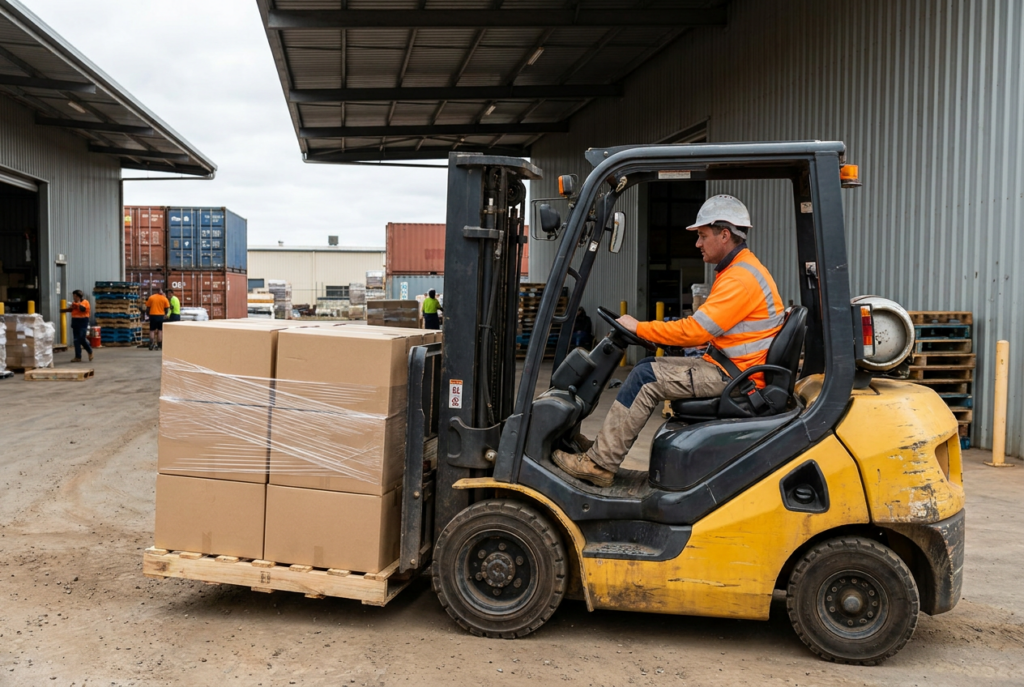
A forklift truck is a powered industrial truck with a mast and an elevating load carriage fitted with fork arms or other attachments that can be raised 900 mm or more above the ground. It does not include a pedestrian-operated truck or a pallet truck. A person performing this work is required to hold a forklift truck High Risk Work Licence (HRWL).

Assessment is competency-based and combines theory with practical demonstration, using the National Assessment Instrument mandated for the licence.

The unit covers the core stages of forklift operation:

  • planning the work or task
  • preparing for the work or task
  • performing the work or task
  • packing up

Find more information on TLILIC0003 – Licence to operate a forklift truck on training.gov.au.


Learning Outcomes

  • Planning the work: checking the task and load details, assessing the operating surface and travel paths, and identifying hazards and controls
  • Preparing the forklift: carrying out pre-start and operational checks and setting up any attachments
  • Performing the work: assessing the load against the data plate and lifting, moving, lowering and placing loads safely
  • Packing up: parking, shutting down, isolating and securing the forklift

On successful completion you receive a nationally recognised Statement of Attainment for TLILIC0003 Licence to operate a forklift truck. Competence in this unit does not by itself grant the licence; you then apply to WorkSafe WA for the forklift High Risk Work Licence separately.


Performance Evidence

Evidence required to demonstrate competence must satisfy all of the elements and performance criteria on at least one occasion and include:

  • applying safe operating procedures, including maintaining a safe speed and travelling with the load lowered to a height suited to the terrain, surface and visibility
  • applying manufacturer requirements, data plate information and any approved attachment modifications
  • carrying out pre-start checks and visual inspection, covering battery and fluid levels, data plates, tynes and attachments, seat, mirrors and seat belt, lights, tyres, signage and safety equipment, and documenting any damage
  • conducting risk and hazard assessment, including lighting, overhead and fixed structures, restricted or poorly ventilated areas, surface suitability, collision risk, dangerous goods and weather
  • complying with Commonwealth, state and territory WHS/OHS legislation, regulations and safe work procedures
  • conducting operational checks of the controls, hydraulic functions, hazard warning systems, steering, transmission, brakes and start-up
  • determining lift requirements, including load weight, centre of gravity, shape, balance and tyne or attachment positioning
  • operating a forklift safely with minimum 250 kg dynamic and non-dynamic loads, including trial lifts, lifting to 75 per cent of maximum height, driving loaded in forward and reverse through an obstacle course and an ‘S’ bend, and placing loads into a racking system and onto an elevated area
  • maintaining communication using warning devices, signage, two-way radio and verbal or written instructions
  • maintaining three points of contact when getting on and off the forklift
  • parking, shutting down, isolating and securing the forklift in accordance with manufacturer and workplace procedures


Knowledge Evidence

Evidence must demonstrate knowledge of:

  • Australian and industry standards, codes of practice and guidelines for operating a forklift safely
  • communication procedures, including warning devices, hand signals, signage, traffic warning systems, two-way radio and written instructions
  • forklift characteristics and capabilities, and manufacturer requirements and instructions for any attachments
  • causes of forklift instability, including overloading, irregular loads, ground deterioration, ramps, and uneven or restricted surfaces
  • reading forklift and attachment data plates and working out whether a load is within capacity
  • responding to unplanned or unsafe conditions such as wind, lightning, rain, wet or icy surfaces, extreme heat and UV exposure
  • lock-out and tag-out and other procedures for equipment faults
  • safe refuelling and battery charging using appropriate PPE
  • recording, reporting and maintaining workplace records
  • the risk assessment process and hierarchy of control: elimination, substitution, isolation, engineering controls, administrative controls and PPE
  • safe use of attachments such as clamps, jib, rotators, fork extensions and work platforms, and their lifting capability
  • shut-down and traffic management procedures
  • work area operating-surface suitability, including cracks, potholes, soft soils, slopes, trench covers and rail tracks
  • WHS/OHS requirements and safe work procedures

PLEASE NOTE:
Australian Advanced Academy (RTO 45286) holds this qualification on its scope of registration and is responsible for training, assessment and certification. This course is delivered on their behalf under a training agreement.

Talk to Our Team

Interested in starting this training? Complete the form below with your information and the Agora team will be in touch shortly to discuss.

This site is protected by reCAPTCHA and the Google Privacy Policy and Terms of Service apply.