Building Skills, Creating Opportunity, and Strengthening Local Communities

TLILIC0020

CO – Licence to Operate a Slewing Mobile Crane (over 100 tonnes)

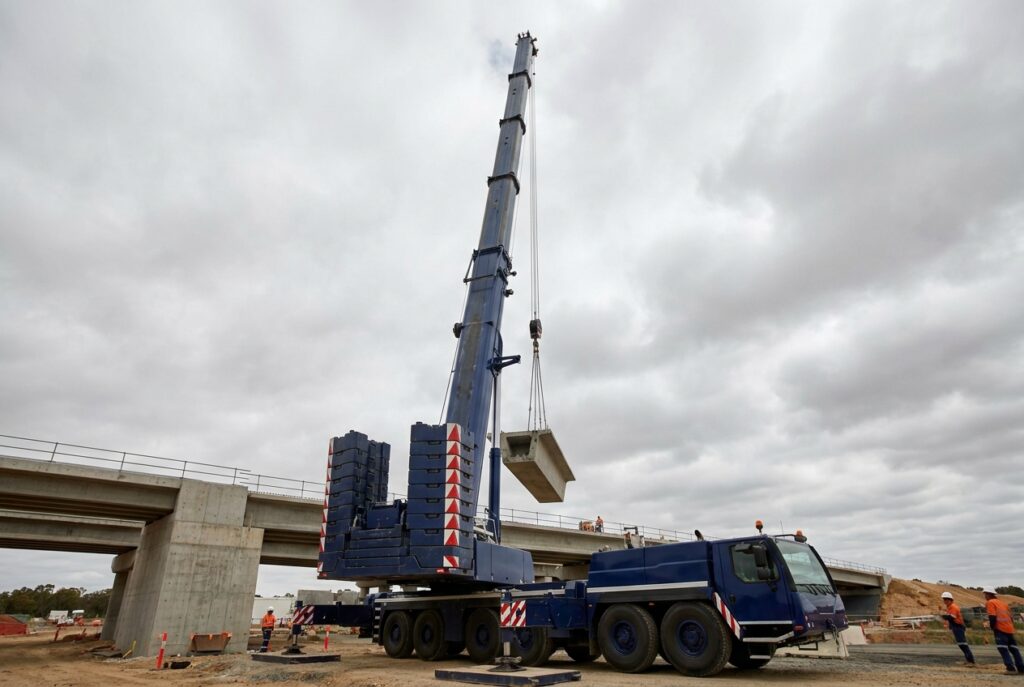
Slewing mobile cranes over 100 tonnes handle the heaviest lifts on major construction and resources projects, and operating one is licensed high-risk work. TLILIC0020 Licence to Operate a Slewing Mobile Crane (over 100 tonnes) builds the skills to plan the lift, set up and stabilise the crane, perform lifts safely within its rated capacity, and pack up on completion. It is your training step towards the CO High Risk Work Licence.
Training Details

This unit covers the skills and knowledge to safely operate a slewing mobile crane with a Maximum Rated Capacity (MRC) over 100 tonnes, in accordance with all relevant legislative responsibilities. A slewing mobile crane is a mobile crane with a boom or jib that can be slewed; it does not include a front-end loader, backhoe, excavator or other earth-moving equipment configured for crane operation.

Assessment is competency-based and combines theory with practical demonstration, using the national assessment instrument mandated for the licence.

The unit covers the core stages of slewing mobile crane operation:

  • Plan the work/task
  • Prepare for the work/task
  • Perform the work/task
  • Pack up

Find more information on TLILIC0020 – Licence to operate a slewing mobile crane (over 100 tonnes) on training.gov.au.


Learning Outcomes

  • Plan lifting work, including confirming task requirements, ground suitability, rated capacity and working load limits, and hazard controls
  • Prepare the crane for work, including set-up, counterweights, fly jib, stabilising, load weight confirmation and slinging technique selection
  • Perform lifts safely within the crane’s rated capacity, using correct crane movements, test lifts and communication signals throughout
  • Pack up the crane, stow lifting gear, counterweight and fly jib, and shut down and secure the crane on completion

On successful completion you receive a nationally recognised Statement of Attainment for TLILIC0020 Licence to operate a slewing mobile crane (over 100 tonnes). Competence in this unit does not by itself grant the licence; you then apply to WorkSafe WA for the CO High Risk Work Licence separately.


Performance Evidence

You must operate a slewing mobile crane configured with at least four parts of line greater than 100 tonnes to lift and move four different loads through an obstacle course, including a 180-degree minimum slew, with the load in full view. Loads must include a load of more than 50% of the crane’s rated capacity with a boom length of more than 75%, a stillage or steel pipe load requiring a dogger, an asymmetrical load requiring a dogger, and a round load at least 300mm in diameter and three metres long requiring a dogger. You must also demonstrate:

  • Applying mathematical calculations with the lift plan and load chart to configure the crane for the load, including boom, counterweights, fly jib, line pull, outrigger positioning and hook type
  • Applying crane movements including luffing, slewing, telescoping, hoisting and travel, and catching load swing appropriately
  • Carrying out operational and pre-start checks, including controls, hydraulics, warning devices and logbook
  • Conducting and applying hazard and risk assessment strategies for ground conditions, dynamic loads, overloading, overhead hazards and weather
  • Communicating with associated personnel using two-way radio, hand signals and written instructions
  • Positioning the crane for safe operation and stability of the crane and load
  • Planning and managing load stability, including confirming lifting gear, calculating WLL deration, and test-lifting to check slinging and load centre of gravity
  • Setting up and validating an exclusion zone, and shutting down the crane in accordance with manufacturer requirements


Knowledge Evidence

You must be able to demonstrate knowledge of:
  • Appropriate workplace communication procedures, including hand signals, two-way radios and signage
  • Crane configuration mathematical calculations to estimate loads and establish counterweight and radius requirements
  • Stability characteristics of non-slewing articulated cranes, vehicle loading cranes and reach stackers compared to slewing cranes
  • Crane and lifting gear load charts and manufacturer requirements, and lift-impacting factors such as centre of gravity, boom deflection and load radius
  • Hazards including ground stability, overhead electric lines, structures and vegetation, traffic, and difficult terrain
  • Set-up of jib, fly jib and counterweights, and outrigger and shutdown procedures
  • Selection, inspection and storage of lifting equipment and gear, and methods of making temporary rope connections
  • Stability of load and avoidance of hazards, and identification of incorrectly slung loads
  • Weather conditions that could affect operations, and work area suitability based on ground reports
  • Risk assessment and mitigation strategies, including the hierarchy of control

PLEASE NOTE:
Australian Advanced Academy (RTO 45286) holds this qualification on its scope of registration and is responsible for training, assessment and certification. This course is delivered on their behalf under a training agreement.

Talk to Our Team

Interested in starting this training? Complete the form below with your information and the Agora team will be in touch shortly to discuss.

This site is protected by reCAPTCHA and the Google Privacy Policy and Terms of Service apply.